LGBTQ+ RIGHTS IN THE NETHERLANDS

Gay and LGBTQ+ RightsLegal Protection in the Netherlands

GayJustice.org is an independent information and public-interest platform focused on gay and LGBTQ+ rights, equal treatment, anti-LGBTQ+ discrimination, police accountability, personal testimonies and access to justice in the Netherlands.

GayJustice.org symbol representing gay and LGBTQ+ rights, equal treatment, legal protection and access to justice in the Netherlands

We publish accessible information about legal rights and reporting procedures, document first-hand experiences and examine cases in which public institutions are accused of discrimination, intimidation, abuse of authority, procedural obstruction or failure to protect the people they serve.

Our work brings together legal information, personal dossiers, supporting documentation, public-awareness projects and practical guidance. We distinguish between established facts, documented records, personal experiences, family accounts, interpretations and allegations that have not been independently established.


25 July – 8 August 2026

WorldPride Amsterdam 2026

Events, Human Rights and Public Awareness

Amsterdam hosts WorldPride from 25 July through 8 August 2026. The programme brings together celebration, visibility, culture, protest, international solidarity and debate about the future of LGBTQIA+ rights.

GayJustice.org is not the official organiser. We provide an independent guide to selected events and publish information about our own peaceful public-awareness activities during the WorldPride period.

Our WorldPride coverage focuses on:

  • the history of Pride as protest;
  • current LGBTQIA+ human-rights concerns;
  • public visibility and equal treatment;
  • police and institutional accountability;
  • peaceful street theatre, satire and visual advocacy;
  • practical information for visitors;
  • official event dates, times and locations;
  • the importance of protecting acquired rights.

WorldPride is a celebration, but it is also a reminder that legal equality does not automatically eliminate discrimination, intimidation, violence or institutional failure. Visibility must be accompanied by protection, transparency and meaningful access to justice.

Explore the WorldPride Amsterdam 2026 guide
WorldPride Amsterdam 2026 — GayJustice.org independent guide to selected events and public-awareness activities

Police Misconduct Affecting LGBTQ+ People in the Netherlands

Personal testimonies concerning discrimination, intimidation, complaint refusals and institutional failure

GayJustice.org publishes attributed personal and family accounts involving reported police intimidation, discriminatory treatment, complaint refusals, alleged abuse of authority and questions about institutional accountability.

Not every negative police interaction legally constitutes misconduct. The legal classification depends on the facts, available evidence and applicable law. Publication of a personal account does not constitute a judicial finding.

Serious reports of discriminatory policing, intimidation, complaint refusal, misuse of authority or excessive force deserve documentation, a fair response and, where appropriate, independent examination.

Explore reported police misconduct and intimidation
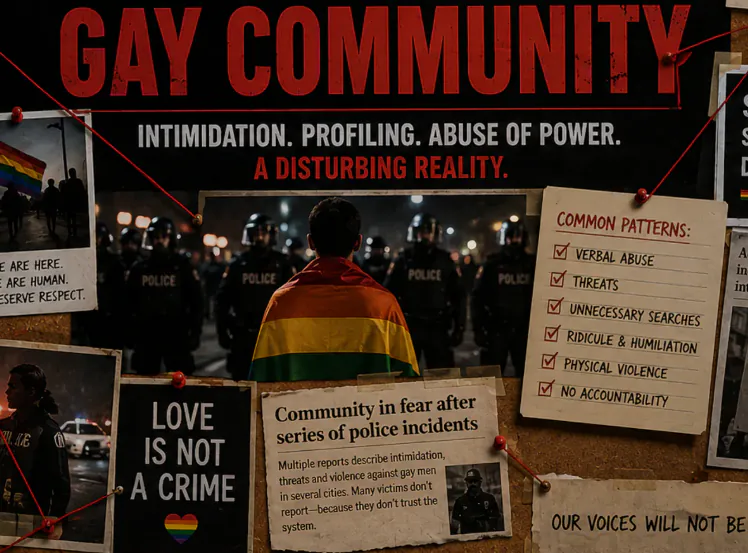
Illustrated Amsterdam protest scene with a rainbow flag, police figures and a GayJustice.org banner

PERSONAL DOSSIER · AMSTERDAM · 2017–PRESENT

Police Homophobia/ Intimidation in Amsterdam

A prolonged period of reported digital disruption, suspected interference, homophobic discrimination, serious accusations and unsuccessful attempts to obtain clarity from public authorities.

Read the complete dossier →
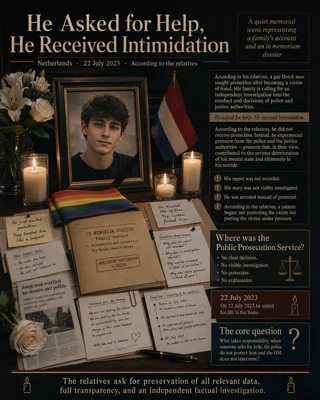
Memorial illustration accompanying a family account of reported police intimidation, institutional failure and the loss of a gay Dutch man

IN MEMORIAM · 22 JULY 2023

Police Intimidation leading to Suicide

A gay Dutch man approached the police after becoming a victim of fraud and expected assistance, but became a victim. His family says that instead of feeling protected, he experienced pressure, provocation and treatment that made him feel as though he had become the suspect. The family claims that the police's actions caused him to commit suicide.

Read the family's account →
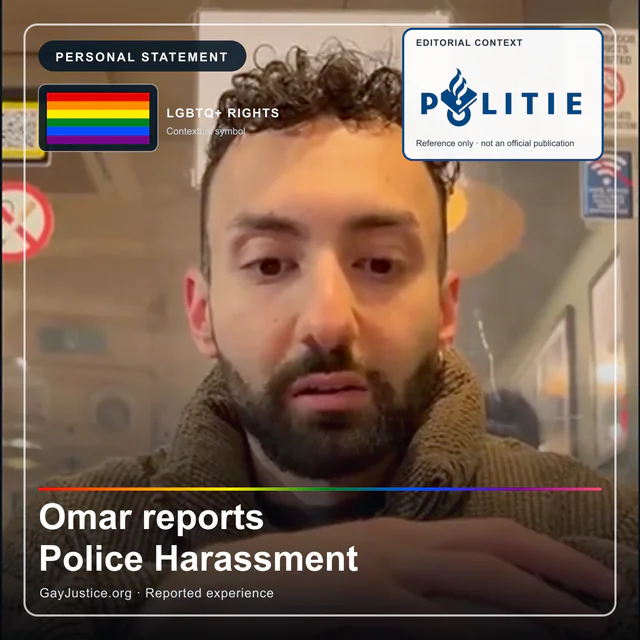
Illustrated poster with a rainbow flag, police figures and text introducing Omar's personal statement

PERSONAL STATEMENT · NETHERLANDS

Police Refused To Take His Complaint

Omar reports that he attempted to make a formal complaint or criminal report to the Dutch police but was not taken seriously and was not given a meaningful opportunity to have his allegations properly recorded.

Read Omar's personal statement →
Gay eagle symbol representing the personal dossier of PW — police homophobia and intimidation in the Netherlands

PERSONAL DOSSIER · NETHERLANDS · 2017–PRESENT

PW — Reported Police Homophobia in the Netherlands

PW describes years of reported digital disruption, homophobic treatment by Dutch police, false accusations of paedophilia and murder, the Recuva discovery, lost businesses Bioherby, CollagenNow and XBORDER, PTSD, and requests for independent investigation and legal redress.

Read the complete dossier →

These dossiers contain personal testimonies and reported experiences. Statements that have not been independently established are identified as allegations, personal accounts or family accounts.


What GayJustice.org stands for

Our platform combines legal information, personal testimony and institutional accountability to advance LGBTQ+ rights and equal treatment.

Rights and legal protection

Everyone must be able to understand their rights and identify the procedures available when they experience discrimination, unequal treatment, intimidation or institutional mistreatment.

GayJustice.org publishes accessible information about:

  • gay and LGBTQ+ rights in the Netherlands
  • equal treatment and human rights
  • discrimination based on sexual orientation
  • gender-identity and gender-expression discrimination
  • workplace, housing and healthcare discrimination
  • police complaints and public accountability
  • access to government and personal records
  • evidence, documentation and burden of proof
  • access to complaint bodies and legal procedures
Explore LGBTQ+ rights →

Personal dossiers and testimony

Personal testimony can reveal experiences that are difficult to identify through statistics, official reports or institutional communications alone.

Our dossiers may contain:

  • first-hand narratives
  • family accounts
  • correspondence with authorities
  • chronological timelines
  • requests for access to records
  • official responses
  • photographs or other supporting material
  • unresolved questions
  • allegations requiring independent examination

We aim to publish personal accounts responsibly, proportionately and with appropriate attribution.

Read the personal dossiers →

Institutional accountability

Police forces, municipalities, prosecution services and other public institutions exercise powers that can significantly affect people's safety, freedom, reputation and access to justice.

Institutional accountability requires:

  • lawful and proportionate decision-making
  • equal treatment
  • accurate recordkeeping
  • effective supervision
  • meaningful complaint procedures
  • protection against retaliation
  • transparency about policies and decisions
  • independent investigation where internal review is insufficient
  • correction when factual or procedural errors are identified

GayJustice.org supports peaceful, lawful and evidence-based advocacy focused on transparency, responsibility and legal redress.

View GayJustice.org projects →

Information, reporting and legal protection

Practical guidance for reporting discrimination, filing complaints and accessing records.

Report LGBTQ+ discrimination

Discrimination can occur at work, in housing, healthcare, education, public services, hospitality, policing or other areas of daily life.

Useful documentation may include:

  • the date, time and location
  • the names or roles of people involved
  • a description of what was said or done
  • emails, letters and chat messages
  • photographs, audio or video
  • witness details
  • employment, housing or medical records
  • copies of earlier reports or complaints
  • a written timeline created as soon as possible

The appropriate procedure depends on the circumstances. Possible routes can include an internal complaint, an anti-discrimination service, the Netherlands Institute for Human Rights, the National Ombudsman, the police, a lawyer or a court.

How to report discrimination →

Police complaints and access to records

People who believe that Dutch police officers acted improperly may be able to submit a complaint, request review or seek access to relevant records.

Depending on the information and authority involved, possible procedures may include:

  • a complaint to the Dutch police
  • a criminal complaint or report
  • a request for police data under the Wpg
  • an access request under the GDPR or AVG
  • a request concerning judicial or prosecution records under the Wjsg
  • a public-information request under the Woo
  • a complaint to the National Ombudsman
  • advice or representation from a qualified lawyer

Different procedures have different purposes. A complaint about conduct is not automatically the same as a criminal report, a public-information request or a personal-data access request.

Police complaints and data-access requests →

Legal and practical guides

Our guides explain important legal and procedural concepts in accessible language, including:

  • equal-treatment protections
  • direct and indirect discrimination
  • harassment and victimisation
  • burden of proof
  • preserving evidence
  • workplace discrimination
  • housing discrimination
  • healthcare discrimination
  • police accountability
  • complaint escalation
  • public and personal data-access requests
  • access to justice
View the legal guides →

Legal notice: GayJustice.org provides general legal information and public-interest commentary. It does not provide individual legal advice, determine legal liability or offer legal representation.


LGBTQ+ Discrimination, Safety and Equal Treatment

Legal equality is important, but formal rights do not always guarantee equal treatment in practice.

Research by European and Dutch human-rights organisations continues to examine concerns involving:

  • anti-LGBTQ+ harassment and violence;
  • safety in public spaces;
  • discrimination at work;
  • unequal access to housing;
  • barriers in healthcare;
  • online threats and hate speech;
  • underreporting of discriminatory incidents;
  • trust in police and public institutions;
  • the experiences of transgender and non-binary people;
  • the position of LGBTQ+ refugees, migrants and homeless young people.

GayJustice.org aims to connect research and legal information with lived experience. Statistics can identify broad patterns, while personal testimony can show how policies and institutional decisions affect individuals.

View LGBTQ+ research, statistics and original sources →

Why Independent Documentation Matters

People who report discrimination or institutional mistreatment often encounter fragmented procedures. One authority may handle police complaints, another personal-data requests, another discrimination claims and another questions about prosecution records.

Important information can become distributed across:

  • police records;
  • municipal systems;
  • prosecution or judicial files;
  • complaint correspondence;
  • medical records;
  • email accounts;
  • internal reviews;
  • public-information decisions;
  • personal notes and timelines.

Independent documentation can help preserve a coherent account of what happened. It can also make it easier to identify inconsistencies, missing records, unanswered questions or possible procedural failures.

A published dossier cannot replace a court, regulator or independent investigator. It can, however, preserve testimony, organise available evidence and make legitimate public-interest questions visible.


Our Editorial Approach

GayJustice.org aims to apply the following principles in everything we publish:

Clear attribution

Personal experiences are presented as personal experiences. Family accounts are identified as family accounts. Allegations are not presented as judicially established facts.

Accuracy and correction

We seek to describe available documentation accurately. Material factual corrections can be submitted through our contact page.

Proportionality

The wording, prominence and detail of a publication should remain proportionate to its public-interest purpose.

Right of reply

Where appropriate and practically possible, identified institutions or individuals may be invited to respond to material allegations.

Separation of fact and interpretation

We distinguish between documented events, the interpretation of those events and questions that remain unresolved.

Privacy and dignity

Publication decisions should consider personal safety, privacy, dignity and the interests of vulnerable people.

Transparency about AI assistance

Content may use AI-assisted research, translation, editing or drafting. Material is reviewed before publication.

Legal responsibility

Our publications are reviewed for legal accuracy. We do not encourage unlawful actions and seek to describe legal rights, procedures and risks correctly.

Cultural sensitivity

We recognise diversity within the LGBTQ+ community and aim to reflect the experiences of different groups with appropriate nuance, respect and inclusivity.


Projects, Advocacy and Public Awareness

WorldPride public-awareness actions

GayJustice.org develops peaceful and lawful public-awareness activities during WorldPride Amsterdam 2026.

These projects may use:

  • visual art;
  • posters and installations;
  • satire;
  • street theatre;
  • public documentation;
  • digital campaigns;
  • educational materials;
  • human-rights messaging.

The purpose is to encourage public discussion about LGBTQ+ rights, discrimination, police accountability and the need for effective legal protection.

Legal-information guides

We develop accessible resources about anti-discrimination law, evidence, complaint procedures, data-access requests and access to justice.

Protection of vulnerable LGBTQ+ people

Our work includes attention to people who may face overlapping forms of vulnerability, including:

  • LGBTQ+ refugees and asylum seekers;
  • homeless LGBTQ+ young people;
  • people experiencing mental distress;
  • victims of fraud, violence or stalking;
  • people who report institutional intimidation;
  • people who lack legal or financial support.

Documentation and preservation

We support the preservation of personal accounts, correspondence, timelines and public-interest documentation where institutions are accused of serious failures.

Explore all GayJustice.org projects →

Latest updates

GayJustice.org at WorldPride Amsterdam 2026

Information about GayJustice.org public-awareness activities during WorldPride Amsterdam 2026, taking place from 25 July through 8 August.

GayJustice.org · WorldPride

Frequently asked questions

What is GayJustice.org?

GayJustice.org is an independent information and public-interest platform focused on gay and LGBTQ+ rights, anti-LGBTQ+ discrimination, equal treatment, legal protection, personal testimonies and institutional accountability in the Netherlands.

The platform is an initiative of Stichting Vrijheid & Gelijkheid, also known in English as the Freedom & Equality Foundation.

What kind of information does GayJustice.org publish?

We publish legal-information guides, personal dossiers, family accounts, research summaries, public-interest commentary and information about peaceful public-awareness projects.

Our subjects include LGBTQ+ rights, discrimination, police complaints, access to records, human rights and access to justice.

Does GayJustice.org provide legal advice?

No. GayJustice.org provides general information and public-interest commentary. It does not provide personalised legal advice, determine whether a legal claim will succeed or represent individuals in legal proceedings.

People facing urgent or complex legal issues should consider consulting a qualified lawyer or appropriate legal-aid organisation.

Where can I read the personal dossiers?

Personal dossiers and family testimonies concerning reported police conduct are available in the Police Files.

The publications distinguish between established facts, available documents, personal experiences, interpretations and allegations that have not been independently established.

Visit the Police Files →

Are the allegations in the dossiers proven?

Not necessarily. Publication does not constitute a judicial or regulatory finding.

Where claims have not been independently established, they are identified as allegations, reports, personal accounts or family accounts. The purpose of publication is to preserve testimony, identify documentation and raise matters that may warrant clarification or investigation.

Can Dutch police refuse to register a criminal complaint?

The answer depends on what was reported, how it was presented and the applicable legal procedure. Providing information, submitting a complaint about police conduct and formally reporting a suspected criminal offence are different processes.

Our police-misconduct guide explains these distinctions and identifies possible complaint and review routes.

View police complaint information →

How can I report LGBTQ+ discrimination in the Netherlands?

Begin by recording what happened and preserving evidence. Depending on the circumstances, possible routes may include the organisation involved, a local anti-discrimination service, the Netherlands Institute for Human Rights, the police, the National Ombudsman or a lawyer.

Read the discrimination-reporting guide →

Can I request access to police or government records?

Different access regimes may apply depending on the authority and type of information. These can include the Woo, Wpg, GDPR/AVG and Wjsg.

A public-information request is not the same as a request for access to personal data. Our guides explain the general differences.

Can I submit my own testimony?

GayJustice.org may consider carefully documented accounts involving alleged anti-LGBTQ+ discrimination, police misconduct, intimidation or institutional failure.

Submissions should distinguish between events personally witnessed, information received from other people, documented facts, interpretations and unresolved allegations.

Contact GayJustice.org →

Is GayJustice.org the official organiser of WorldPride Amsterdam 2026?

No. GayJustice.org is an independent platform and is not the official organiser of WorldPride Amsterdam 2026.

Our WorldPride page provides an independent event guide and information about GayJustice.org public-awareness activities. Final event details should be verified through official event sources.

Independent, Transparent and Accountable

GayJustice.org is an initiative of Stichting Vrijheid & Gelijkheid, an independent foundation under Dutch law.

We recognise that public-interest reporting about discrimination, police conduct and institutional failure requires care. We therefore seek to distinguish clearly between:

  • established and documented facts;
  • first-hand personal experiences;
  • family testimony;
  • allegations;
  • interpretations;
  • unresolved questions;
  • matters requiring independent investigation.

We support accuracy, proportionality, transparency, correction of factual errors and meaningful accountability.